 |
 |
  |
 |
  |
 |
 |
|||
 |
 |
 |
 |
 |
||
| reference articles | competition journal | piping links | FAQ | contact me |
Andrew Lenz's BagpipesA real-life case study of identifying the maker of the set of bagpipes. |
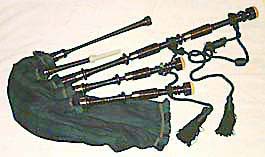
 bagpipe makers. I e-mailed Iain McLeod (who was in his early seventies) to see if he could confirm the make of my pipes. (Iain McLeod bought the Gillanders company in 1972 from Bert Gillanders.) Up until I told him the story of my grandfather buying the pipes, he thought it was pretty likely that the set was Gillanders & McLeod—but then he thought different. Then he thought they might be J&R Glen pipes, with a Gillanders & McLeod chanter which were often obtained to sell with those drones: "Old Andrew frequently obtained a McLeod chanter to sell with his own drones." Apparently my description of the person who sold the pipes was very typical of the late Andrew Ross who owned J&R Glen. According to Iain, "Andrew was a real Edinburgh worthy and very particular in selling his bagpipes to 'real' musicians." But Iain said that without closely scrutinizing the drones himself, he couldn't say for sure what the make was.
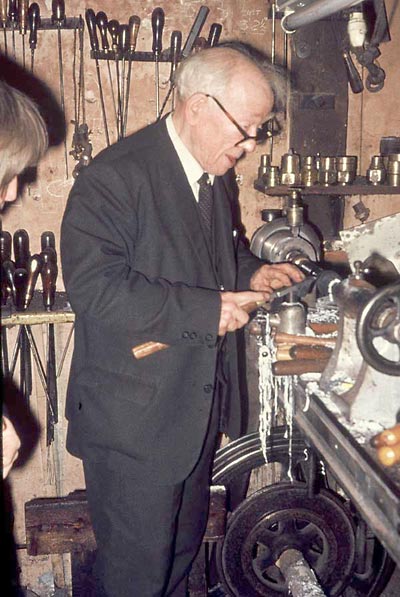 |
| Andrew Ross at the lathe in his shop in Edinburgh in 1976 or 1977. Photo by Josef Hartmann-Virnich (of Cologne, Germany). Used by permission of his son Andreas Hartmann-Virnich (whose nose is seen at the left of the photo). |
One retailer, judging from my (not very crisp) digital pictures, was "positive" that these pipes are "Graingers." That is, made by the business Grainger & Campbell, founded in 1946 by George Grainger and Neil Campbell, and closed in 1989. Another retailer based in the Western USA, who very briefly looked at my pipes in person at a games in October 2003, was also convinced that these pipes are Graingers, and believed they were made while Donald MacLeod managed G&C from 1959 until 1982 when he passed away. At the time, I was convinced.
On December 18, 2004, a man named Ivan Dodson and his wife Pat happened into our family business to have a piece of artwork custom framed. I was chatting with them and discovered—purely by chance—that they knew my grandfather. "Warren. I fixed his 'canter' for his bagpipes." I was happily shocked. "I was just holding that very chanter last night and that set of bagpipes is in my office right now!" Mr. Dodson (in his 60s) extended his hand and with a warm smile: "Good for you." I asked about the chanter break and he related the story of the chanter having been broken by someone sitting on them. We talked a bit out his repair business (now only along the lines of violins), music (he plays the banjo), and local history. I called my grandmother that night and she was delighted to hear of the meeting and though she said she didn't recall the "chanter sitting" event, she said it wouldn't surprise her as he often took the pipes to parties and may have left them where someone carelessly sat on them. I had always assumed it was simply a matter of him trying to get the chanter out of a very tight stock by twisting at the sole end, but now I know I was mistaken. Somebody simply sat on it.
In October 2005, John Nieder of Oregon e-mailed me photos of two sets of Grainger pipes (1973 & 1974) belonging to his son. He also noted the differences in our sets of bagpipes. In November 2005, at my request, Rick McFarland provided some photos of his 1973 Gillander & McLeod pipes.
 |
 |
 |
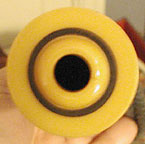
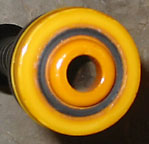
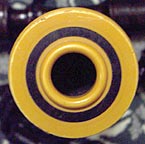
| 1973 Grainger Cap | 1975 Grainger Cap | 1977 Grainger Cap |
 |
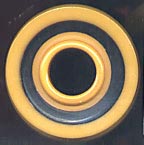 |
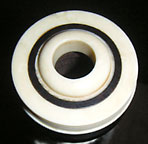
| 1973 Gillander & McLeod Cap | My pipes |
It's not hard to tell from the photos above that there's some significant differences in the construction between the Grainger bass drone cap and the others. I've been told that the G&M design and the design of my drone top is fairly common among a variety of makers.
 |
 |
 |
 |
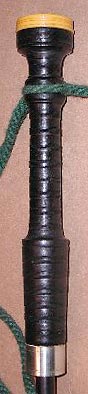
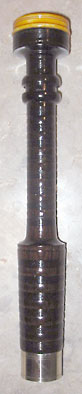
| 1973 Grainger Bass |
1975 Grainger | 1973 Gillander & McLeod | My pipes |
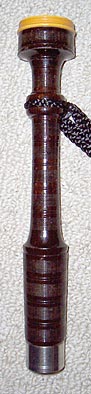
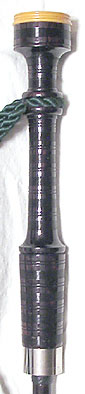
In the above photos of the bass drone tops we see a few differences. The body of the drone is "beefier" on the Graingers. The nickel ferrule on the Grainger has a single scribed ring at the top and a double ring at the bottom—mine, double ring at the bottom only, though this could be arbitrary. The Grainger's drone cord rings are located significantly higher on the drone than mine. It also appears that the drone top of the Grainger's is a touch shallower than my pipes. The G&M and my pipes look very similiar in shape and the flat nature of the combing and beading, though the G&M has ten combing grooves to my seven.
In mid-November 2005, I showed a 1970s photo of the J&R Glen shop in Edinburgh (of Andrew Ross fame) to my very active 90-year-old grandmother and, tapping the paper, she said the name immediately above the door definitely rang some bells. (Granted, it had been 30 years since her visit there!) When I described the store interior (dark, gas lamps, packed), she said that was a correct description of the shop—in contrast, the pipe shop across the street was clean and well-lit (Highland House which was then run by George Stoddart), but the encounter with idiosyncratic Andrew Ross shop was unmistakable. (There are wealth of stories such as Ross requesting a cassette tape of a potential client for evaluation of the client's playing.) I don't believe there is much question that the pipes came from Andrew Ross' J&R Glen shop. Before his death in 1979, Andrew Ross sold his shop to Gordon Stobo—maybe as early as 1976—who ran it for a number of years before closing the shop down in the 1980s and moving to Australia. The Ross tools went to one of Stobo's turners, Joe Hagan, who made Clan Bagpipes, but he is now retired.
On November 16, 2005, after posting a question at BobDunsire.com's forums about Glen pipes, a North American bagpipe maker e-mailed me saying "Those are probably J&R Glens. It is very unlikely they are Graingers. Gillanders is possible (bought in by Old Andrew), and much more probable than Graingers or Hardies. [Edited.] These are good examples of the pitfalls of identifying pipes that are not readily identifiable, and why you'll so rarely see me stick my neck out to put a name on a mystery pipe."
So what are these pipes? Glen's? Gillander's? Grainger's of some form? Based on where they came from, Glen's or Gillander's are most likely. While Hardie's were purported to be sold in a pinch through the J&R Glen shop, this is less likely.
On Thanksgiving, November 24, 2005, on a visit to my grandmother's house, I rummaged around in her upstairs closet to find some of my grandfather's remaining piping related items. A long thin box containing a cheap Pakistani bagpipe (he was hoping one of his grandkids would learn—while he was alive, but that didn't happen unfortunately), a paper bag containing a custom green bag cover with gold trim (sewn by a friend in the local Irish Club), and a thinnish box marked in pen with "Drone Reeds," but officially labeled: "A Bagpipe Practice Chanter by R. G. Lawrie, LTD. Glasgow Second to None."
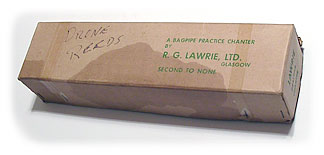
Now, in the box was not a practice chanter—I inherited a Hardie practice chanter, not a Lawrie, go figure—instead was a variety of cane drone reeds and a small thin box labeled "Wills Castella Cigars" containing five more cane drone reeds. Of particular interest in the box was a 3"x6" flat package with two more cane drone reeds, from Highland House, 328 Lawnmarket, Edinburgh EH1 2PN. You can just make out part of the postmark on the two "9P" stamps, "25 JA..." so January 25th. The rest of the postmark is long since gone on the yellowed cellophane tape—or the ink could have just smeared off in mailing.
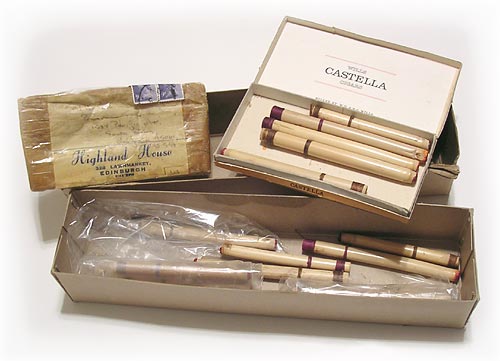
Now this, of course, gives me a bit of a quandry. Most people order supplies from an established relationship, so the question is: was my grandfather using an existing relationship when he ordered the drone reeds from Highland House or not? From paperwork in my pipe case when I first inherited it, I know later he did order from another supplier. I know that on April 21, 1985, Tom Speirs of J&C Speirs in Edinburgh wrote a reply letter to my grandfather telling him that he was having "Naill" [David Naill & Co.] "supply a chanter direct" and his hope was that my grandfather would feel that "the wait is worth the amount saved." I also have an "air mail post" Customs Declaration "1 Highland Pipe Chanter" from Naill dated "18 - 2 - 1986"—roughly nine months from the date of the letter. My grandfather passed away about two years later so one would assume that the chanter saw at least some use. I don't know where my grandfather got the Speirs contact information. I know from the Speirs' reply letter that my grandfather had mentioned his attendance at a piping school in Pebble Beach in August 1984. (Which I'm nearly positive was taught that year by the legendary Seamus MacNeill of The College of Piping in Glasgow.) Perhaps it was at the school that Speirs' address was given, we'll probably never know.
My grandmother remembers the shop being on the right when coming down the hill from the castle. This complicates things, as the Glen shop was on the left at 497 Lawnmarket! Highland House was on the right at 328 Lawnmarket. But, my grandmother said it's been a long time and memories aren't perfect.
In mid-October 2006, Kevin Gilstrap provided photos (bass drone & cap) of his 1975 Grainger & Campbell pipes. Jim Mills also sent me a photo of the cap of his 1977 Grainger & Campbell pipes which he says were hand-selected by John MacFadyen. These I've integrated into the photo comparisons above.
Based on a variety of things—including the consistent convex nature of the bush at the drone top—we can safely eliminate Grainger & Campbell as a possibility as the make of my pipes.
Also in mid-October 2006, Alec Smith of the Isle of Wight, England (a former turner for David Naill & Co.) pointed out the similarities between a set he has and my set. He picked the set up on eBay and the ebony chanter included with the pipes was stamped "R Gillanders, Forfar" indicating a possible, but not sure, link of the drones themselves with Gillanders.) If you look at the company history page of the Gillanders and McLeod website, they tell that Robert Gillanders was a turner with the Thow Brothers in Dundee until he left in 1926 to start his own company Robert Gillanders - Bagpipe Makers. Right around 1956 the shop moved to Forfar and the name was changed to R. Gillanders & Son. Assuming the chanter belongs with Alec's pipes, the tenor drone in the photo below would have been made between 1956 and 1972 at which point Iain McLeod bought the company and changed the name to Gillanders & McLeod.
Alec's, followed by mine:
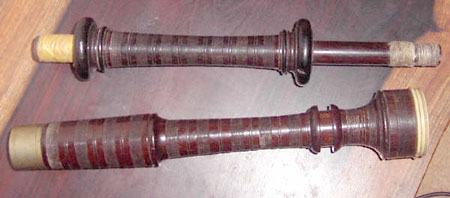
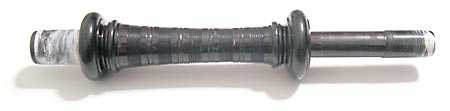
The tenor bottoms look fairly similar, eh? Rare flat combing and everything.
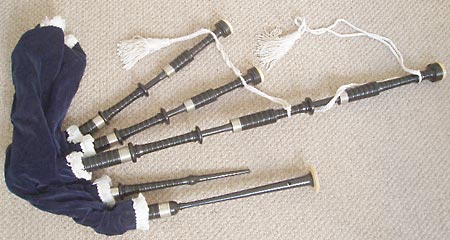
Also in late-October 2006, Yann Le Lan of France provided a picture of a set of Thow Brothers pipes. The Thow Brothers's company was in business from 1853 until 1953, quite a range of dates, though I'd say the pipes shown are 20th Century.
Thow Brothers . . .
. . . and my pipes:
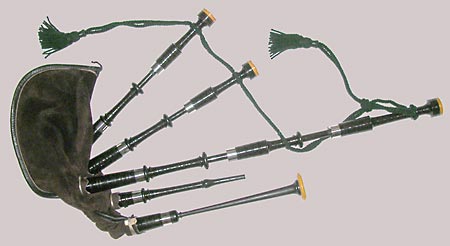
Now, the Thow bagpipes are the closest match I've seen—at least from a distance, as I can't really make out the combing. I don't have any close-ups of the Thow pipes. If they are in fact very similar, this would point back to the pipes being Gillander & McLeod, as Robert Gillander learned his trade from the Thow Brothers.
Gillander & McLeod appears to be in the lead . . .
In early May 2007, I e-mailed Douglas MacPherson, a pipermaker in Forfar who was the last apprentice of Robert Gillanders. He replied, "Had a look at your pipes I think you're right G&M, I'm surprised they are not stamped in the cord groove, might have been made in the change over from Gillanders & Sons to Gillanders & McLeod, Looking at the shape of the chanter ball and the cord groove I would say Bob Gillanders turned them."
In early December 2008, Mark Gibson (no relation to Jerry Gibson, pipemaker) e-mailed saying he bought a set of pipes from the Gordon Stobo in the Glen shop in August 1978—that he still had the receipt. His pipes were very similar though the bell of bass drone top is deeper on his set. At first he was pretty convinced that his pipes were Glen pipes that came with a McLeod chanter, but then after more reading and checking, he thought they might be G&M pipes sold through the Glen shop. His final conclusion is that he might never know for sure.
In mid-July 2009, in response to a discussion I started at the BobDunsire.com forums about white mouth pieces, Colin MacLellan (Gold Medalist and former president of the Competing Pipers Association) related his experiences working for Gordon Stobo at the Highland House and how Andrew Ross would sneak across the street to procure a set of G&M pipes from the Highland House, which he would in turn sell to unsuspecting tourists as "authentic J&R Glen" pipes.
This would lend creedance to the theory that the pipes purchased through the Glen shop by my tourist grandparents are G&M pipes. At the very least, it's extremely possible and not far-fetched in the slightest. Particularly that Gordon Stobo was a big fan of white plastic mouth pieces, as found on my set when I inherited it.
In mid-October 2009, David Thompson of Pennsylvania contacted me expressing his strong opinion that my pipes are G&M. He purchased his first G&M set in 1977 from the Highland House of Woodstock, Ontario (not the Edinburgh-based shop of the same name). The Canadian Highland House was run by Alex Robertson (former Seaforth Highlander) who was a good friend of G&M's Iain McLeod. David was pipe major of the Grove City Highland Band for 10 years beginning in 1984 and almost every set in that band were G&M pipes. He also said, "Another point that may be of interest to you is that none of the G&M pipes in our band had a G&M stamp on any of the sections and none in the cord groove area either." Also, "...the exterior shapes of your drone sections, they are an exact match to mine."
On October 21, 2009, I heard back from Colin MacLellan after I pointed him to this page. Here was his reply:
|
"Hi Andrew That's all great. I was sort of laughing when I was reading the very detailed (and interesting) story about the years of research about your pipes. We sold hundreds of those sets of Gillanders and MacLeod, there is no doubt whatsoever that your pipes are 100 percent Gillanders and MacLeod, I could have saved you a lot of bother, but at least you had an interesting journey with it! Those ones of yours were called 1/2 combed with art ivory mounts (G and M never referred to artificial ivory, only art ivory) with nickel ferrules, but they are in fact stainless steel, G and M were the only company to use stainless. So there you go. The white mouthpiece - it looks hideous today but in those days we quite liked the look of them. Trends and tastes change! Colin" |
That draws this research project to a close. All the evidence was pointing to what Colin confirmed, that is, my pipes did indeed come from the Gillanders & McLeod workshop. Iain McLeod on October 22, 2009 related that the late Bob Gillanders "was with us for many years after I took over the company in 1972." It's extremely likely that my pipes were, as Douglas MacPherson said a couple years ago, turned by Bob Gilllanders—but there's no doubt of the make, Gillanders & McLeod.
Photos of Andrew's Pipes.
Due to lighting, sections of the pipes appear below to be dramatically lighter wood. This is not the case. While one section is lighter, it's not very noticeable. It's exaggerated by the photographic process.
For more pictures (each with a ruler for scale) see my second page of image of my pipes.
At the very top of this page is what the whole set looked like before I began playing. The chanter is of the Naill brand purchased by my grandfather to replace the original which broke.
I've since replaced the cording and bag cover and also changed the mouth piece.
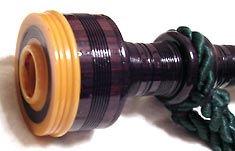
Bass drone top.
The bass drone top is 1-13/16" across, the tenor drones are slightly smaller at 1-3/4". The outside diameter of the inlaid wood rings in the drone tops are 1-3/8" on the tenors and 1-7/16" on the bass.
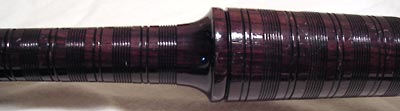
Upper portion of the bass drone.
The combing around the drones are tight groups of seven grooves (forming the appearance of six "raised" rings) separated by a larger pair of grooves that are slightly wider apart.
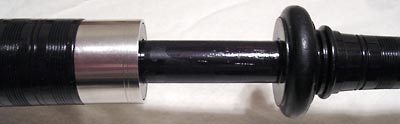
Bottom tuning pin of the bass drone.
Here you can also easily see the wood projecting mount—though in this case, it's not a mount, per se, it's simply part of the wood.
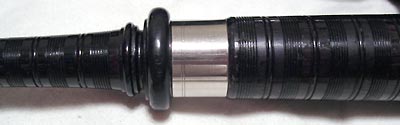
Stock's ferrule and lower section of the bass drone.
All the ferrules all have twin rings around them, about an sixteenth of an inch apart. On this image (and some others) you can see where some of the original varnish has peeled off. Most pipe makers these days just oil the outside since varnish has a hard time sticking due to the oily nature of African Blackwood.
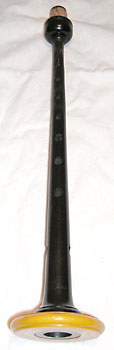
The original chanter.
"McLEOD" at the top,
The chanter is 14-5/16" long.
This chanter was broken at the top, around the High-A and High-G holes. This is a common break of a chanter that has swollen by moisture then removal is attempted by twisting from the sole end (bad habit) instead of the top near the stock (good habit).
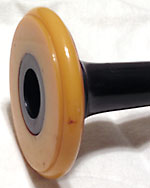
What the sole looks like.
It's 2-7/8" across. The outer diameter of the wooden ring is 1-3/8", the opening is 7/8" The side holes on the chanter start 2-3/16" up from the top of the sole and are just under 3/8" in diameter. You may notice that the wood has shrunken from the imitation ivory sole, this is due to the fact that it hasn't been played or oiled in over a quarter century.
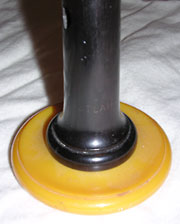
The top side of the sole.
Here you can faintly see the "MADE IN SCOTLAND" on it 1" above the sole. The first two words are centered above the "SCOTLAND". The text is in a san serif typeface (very plain block) and each line is just under an eighth of an inch tall.
The top is not flat, but a little concaved. There's a lip on the sole about 3/16" in from the outside edge, both on the top side as well as the bottom. However the bottom of the sole is flat.
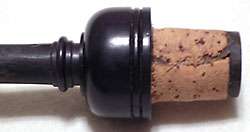
The stock end of the chanter.
Ringed with cork, which is a less common method these days. The knob, that butts up against the stock, has two rings about a sixteenth of an inch apart grooved into the wood, but the wood between the two rings has been rounded off, creating an effect like a round band has been sunken into a groove.
For more pictures and detailed measurements, see my second page.
Contact me with questions or comments.
This page last updated Monday, August 8, 2011.
Page first created in 1999 or early 2000.
| sitemap | ||
 |
 |
||
 |
|||

